
“An ounce of prevention is worth a pound of cure.” (Benjamin Franklin)
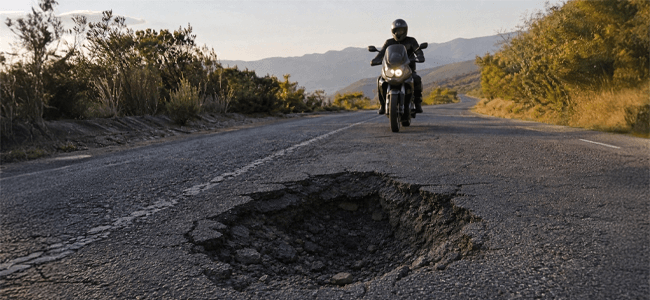
On New Year’s Day in 2012, the rider was travelling along Airport Road (MR347), between George Airport and Blanco, when his motorcycle struck a pothole approximately 600mm wide.
He lost control, collided with a signpost and suffered severe injuries that ultimately required the amputation of his leg. The pothole had existed for several weeks and was difficult to see because its colouring blended with the surrounding road surface.
No automatic liability
The fact that an accident was caused by a pothole does not, by itself, make a public authority liable.
A claimant must establish the ordinary requirements for a damages claim, including wrongful conduct, negligence, causation and harm. Where the alleged wrongdoing is a failure to act, the Court also has to ask whether the authority was under a legal duty to repair the defect or warn road users about it.
In this case, the Department accepted that it had a duty to maintain the road in a reasonably safe condition. The Court found that this was an obvious case in which the circumstances imposed a duty to repair the pothole or provide an adequate warning.
They knew, or should have known
The size and age of the pothole were crucial. The Court accepted evidence that the roads authority had been alerted to the pothole before the accident. But even without a complaint, the defect was sufficiently large and had existed for long enough that a reasonable roads authority should have discovered it during its inspections.
The authority’s own records showed that formal inspections had taken place without the pothole being recorded, while its witnesses accepted that a defect of this size would probably have prompted complaints from road users.
That amounted to constructive notice: in other words, the authority should have known about the danger even without proof that the pothole had actually been reported.
The road itself was also nearing the end of its design life and was known to be prone to potholes. Yet there were no warning signs, the inspection system had been poorly executed and maintenance records were incomplete. The Court found that the failure to repair the pothole or warn motorists was both wrongful and negligent.
But should the rider have seen it?
The Department argued that the rider had a long, unobstructed view of the road and should have been able to see and avoid the pothole.
The Court disagreed.
Evidence showed that the pothole was difficult to distinguish from the road surface. The Court found that the rider had maintained an appropriate lookout and could not reasonably have been expected to see the defect before striking it. The pothole was described as a “hidden trap” that created a sudden emergency.
The Court was also satisfied that the pothole caused the crash, rejecting a reconstruction exercise relied on by the Department because it did not sufficiently replicate the actual accident.
Liability now, damages later
The Court decided that the Department was responsible for the accident, with the amount of compensation to be determined separately.
The Department was also ordered to pay legal costs on the higher attorney and client scale, including counsel and expert witness costs. The Court imposed this more severe costs order because of the way the defence had conducted the litigation, describing it as “ambush litigation” that delayed proceedings, increased costs and pursued issues that were later conceded.
The lesson is not that every pothole creates a claim against the State. Liability depends on the circumstances, including how dangerous the defect was, how long it had existed, whether the responsible authority knew or should have known about it, what inspection and maintenance measures were in place, whether warnings were given and whether the pothole actually caused the loss.
Injured because of a dangerous road defect? Speak to us about whether you may have a claim.
Disclaimer: The information provided herein should not be used or relied on as professional advice. No liability can be accepted for any errors or omissions nor for any loss or damage arising from reliance upon any information herein. Always contact us for specific and detailed advice.
© LawDotNews