
“You do not mend a broken vase by handing over a new one.” (Anonymous)
When a property sale is cancelled, most people picture a straightforward reset. The seller keeps the property, the purchaser gets the money back, and everyone walks away as if the deal never happened.
The law calls this restitutio in integrum, and a recent Gauteng High Court decision shows that putting the parties back where they started can be a far more exact exercise than simply reversing the transaction.
Restitution is not a reset button
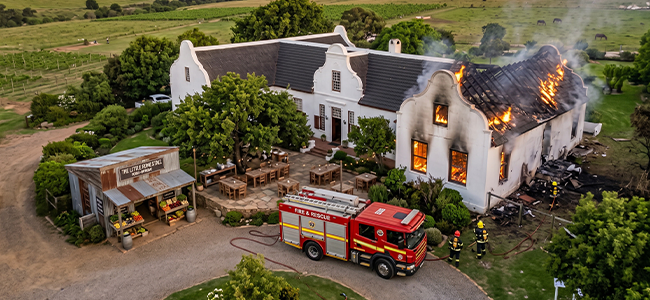
The dispute followed the cancellation of a sale involving a smallholding in Kyalami. The purchaser had taken occupation of parts of the property, including a restaurant and farm stall. Transfer had not yet taken place because the financing and other conditions attached to the sale had not been finalised.
In December 2017, while the purchaser was still in occupation, an arsonist set fire to the restaurant. Neither party had caused the fire, but the sale agreement placed the risk of damage on the purchaser. The financing arrangements and other conditions remained unresolved, and the purchaser cancelled the agreement in May 2018 without transfer ever having taken place. He was entitled to repayment of R2,15 million, less the fair and reasonable cost of repairing the fire damage. The court had already decided that the repair costs must be deducted from the purchaser’s refund, but the amount of that deduction was only determined in 2026.
The principle of restitutio in integrum requires the parties to be restored, as far as reasonably possible, to the positions they held before the agreement.
That sounds simple in theory. In practice, years may pass between occupation and cancellation, and the property itself rarely stays the same. A building can be damaged, deteriorate, or simply age. When that happens, restitution has to account for the difference between what was handed over and what is being handed back.
Old does not come back new
The court had to assess the fair and reasonable cost of remedying the fire damage to the restaurant and farm stall, taking into account the condition of the structures when the purchaser took occupation. Parts of the restaurant and farm stall were already in poor condition, and some earlier work had been badly done.
Restitution could not be used to turn an aged or poorly built structure into a new one at the purchaser’s expense. Where a proposed repair would leave the seller with something materially better than what existed before, the court reduced the amount allowed.
The purpose is to restore what was lost, not improve what was already there. The question was not what it would cost to replace the structures with new ones, but what it would fairly cost to restore what had actually been damaged.
You can’t deduct the same problem twice
The purchaser argued that, after the court had calculated the cost of each repair, the overall figure should be reduced again to reflect the property’s poor condition before the fire.
The court rejected this argument. It had already reduced the relevant repair amounts to reflect the structures’ age, poor condition, and substandard workmanship. A further general reduction for the property’s overall condition would therefore have deducted for those same problems twice.
The court fixed the fair and reasonable cost of restoration at about R1.36 million. After this was deducted from the R2.15 million repayable to the purchaser, the seller still owed him about R799k.
Record the condition, or argue about it later
The judgment also shows why you should record a property’s condition when occupation changes hands.
Where there is no clear record of what a property looked like at handover, parties may be left arguing years later about whether a structure was sound, dilapidated, damaged, or badly built before the purchaser arrived.
Photographs, walk-through videos, inspection reports, inventories, and records of existing defects can matter far more than memory if a sale later collapses and restoration becomes disputed.
In this matter, the condition of the restaurant and farm stall when the purchaser took occupation formed part of the court’s assessment of what fair restoration required.
Why the date of cancellation matters
The passage of time did not postpone the financial consequences until the date of judgment.
The sale agreement was cancelled on 31 May 2018. The parties had agreed that interest on any amount ultimately found owing would run from that date, and the court had already made an order to that effect.
By the time the restoration dispute was finally decided in 2026, more than R613k in interest had accrued on the outstanding amount.
Bottom line
Buying or selling property and handing over occupation before the deal is complete? Speak to your attorney about recording the property’s condition and making sure the agreement clearly deals with risk.
Disclaimer: The information provided herein should not be used or relied on as professional advice. No liability can be accepted for any errors or omissions nor for any loss or damage arising from reliance upon any information herein. Always contact us for specific and detailed advice.
© LawDotNews