

Divorce is never only a legal process. It is often emotionally taxing, financially disruptive, and practically complex. Even where both spouses agree that the marriage has come to an end, the legal consequences of divorce can extend for years, particularly where children, property, or ongoing financial obligations are involved.
This guide explains the legal framework governing divorce in South Africa, what must be decided before a divorce can be finalised, and why careful legal advice matters - even in cases that appear “simple” at the outset.
What is a divorce in South African law?
A divorce is a court order that formally dissolves a valid marriage. Separation alone has no legal effect. Until a divorce order is granted, spouses remain legally married, with all the rights and obligations that status entails.
Divorce proceedings in South Africa are governed primarily by the Divorce Act 70 of 1979, which regulates:
- the grounds upon which a marriage may be dissolved
- how the court must deal with children of the marriage
- the division of property and patrimonial consequences
- spousal maintenance and related relief
A divorce can only be granted by a court with jurisdiction, typically the Regional Magistrates’ Court or the High Court.
Grounds for divorce: a no-fault system
South Africa follows a no-fault divorce system. This means that a spouse does not need to prove blame, wrongdoing, or misconduct such as adultery or abuse in order to obtain a divorce.
Irretrievable breakdown of the marriage
The most common ground for divorce is that the marriage has broken down irretrievably, with no reasonable prospect of restoration. Courts assess this by looking at the factual circumstances, which may include:
- a prolonged period of separation
- loss of love, affection, or mutual support
- a complete breakdown in communication
- repeated conflict with no prospect of resolution
The court is not concerned with who is “at fault”, but whether the marital relationship has effectively ended.
Mental illness or continuous unconsciousness
Less commonly, a divorce may be granted on the grounds of:
- the mental illness of a spouse, or
- the continuous unconsciousness of a spouse
These grounds are strictly regulated and require medical evidence and compliance with statutory safeguards.
How divorce proceedings are started
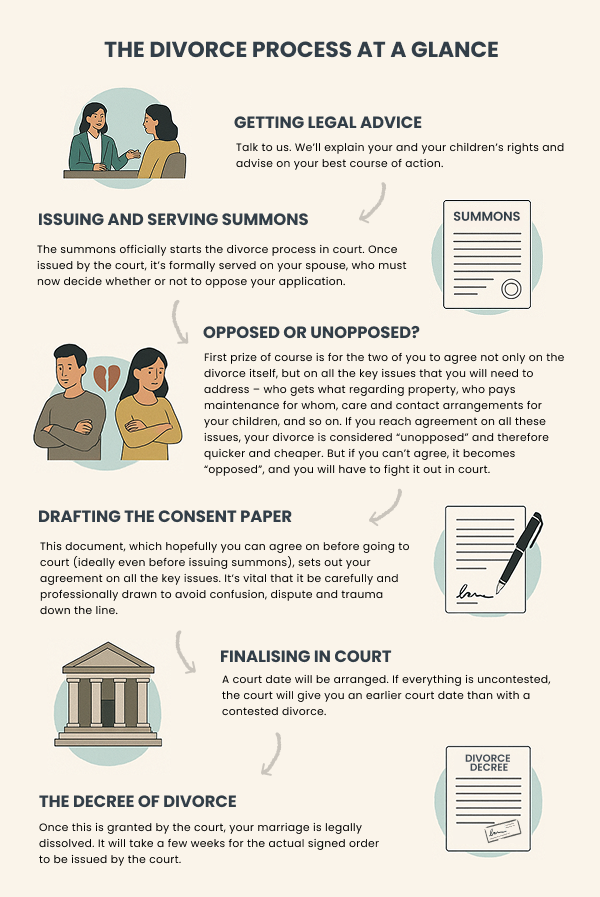
A divorce is initiated when one spouse (the plaintiff) issues a divorce summons out of the appropriate court. The summons sets out:
- the basis for the divorce
- details of the marriage
- what relief is sought in relation to children, property, and maintenance
The summons must be formally served on the other spouse (the defendant) by the Sheriff of the Court.
If the defendant does not oppose the divorce, the matter may proceed on an uncontested basis. If the defendant disputes any aspect of the divorce, the matter becomes contested.
Uncontested vs contested divorce
Uncontested divorce
A divorce is uncontested when both spouses agree on all material issues, including:
- care and contact arrangements for minor children
- child maintenance and, where applicable, spousal maintenance
- division of assets and liabilities
In uncontested matters, the parties usually conclude a settlement agreement, which is made an order of court. Where children are involved, the court must still be satisfied that the arrangements are in their best interests.
Uncontested divorces are generally faster, less expensive, and less adversarial.
Contested divorce
A divorce becomes contested when the spouses cannot agree on one or more issues. Common areas of dispute include:
- where children should live
- how contact should be exercised
- maintenance obligations
- division of assets
- interpretation or validity of an antenuptial contract
Contested divorces can involve extensive litigation, interlocutory applications, expert reports, and trial proceedings. These matters often take years to finalise and carry significant emotional and financial cost.
Children: care, contact, and maintenance
Where a divorce involves minor children, the court’s overriding consideration is the best interests of the child.
Parenting plans
Parents are encouraged to agree on a parenting plan, which typically addresses:
- primary residence (care)
- contact schedules
- decision-making in relation to schooling, healthcare, and religion
- communication between parents
If agreement cannot be reached, the matter may be referred to the Family Advocate, or determined by the court.
For focused guidance, see our services relating to
Child Custody and Maintenance.
Maintenance
Both parents have a legal duty to maintain their children according to their respective means. Maintenance is assessed with reference to:
- the reasonable needs of the child
- each parent’s income, assets, and earning capacity
Spousal maintenance may also be claimed in appropriate circumstances, either during the divorce proceedings or on a rehabilitative or ongoing basis after divorce.
Property and matrimonial regimes
The way in which assets and debts are divided on divorce depends on the matrimonial property regime applicable to the marriage.
In community of property
Where spouses are married in community of property:
- all assets and liabilities fall into a joint estate
- the joint estate is generally divided equally on divorce
Out of community of property without accrual
Where spouses are married out of community of property without accrual:
- each spouse retains their own assets and liabilities
- there is no sharing of estates on divorce
Out of community of property with accrual
Under the accrual system:
- each spouse retains a separate estate during the marriage
- the growth (accrual) of the estates during the marriage is shared on divorce
The existence and wording of an antenuptial contract (ANC) is critical. Disputes over ANCs are common in contested divorces and can significantly affect outcomes.
Further detail is available under
Antenuptial Contracts.
The role of mediation
Mediation can be a valuable tool in divorce matters, particularly where:
- communication between spouses has broken down
- children are involved
- the parties wish to avoid prolonged litigation
In mediation, a neutral mediator assists the parties in negotiating mutually acceptable outcomes. Agreements reached through mediation can be incorporated into a settlement agreement and made an order of court.
Learn more about dispute-resolution options under
Mediation and Arbitration.
Costs and timeframes
There is no fixed cost or duration for a divorce. Factors that influence both include:
- whether the matter is contested or uncontested
- the complexity of financial and parenting disputes
- court backlogs and procedural delays
While uncontested divorces can sometimes be finalised within months, contested divorces often take significantly longer.
When should you consult an attorney?
You should seek legal advice as early as possible if:
- there are children involved
- you are unsure which matrimonial regime applies
- significant assets or debts are at stake
- there is an imbalance of power or information between spouses
- you wish to negotiate a settlement or protect your position
Comprehensive assistance is available through our
Family and Divorce Law services.
Disclaimer
The information provided herein is for general information purposes only and should not be used or relied upon as legal or professional advice. No liability can be accepted for any errors or omissions, nor for any loss or damage arising from reliance on this information. Legal outcomes depend on the specific facts and applicable law. Always consult a qualified attorney for advice tailored to your circumstances. You may contact our attorneys here to discuss your specific matter.